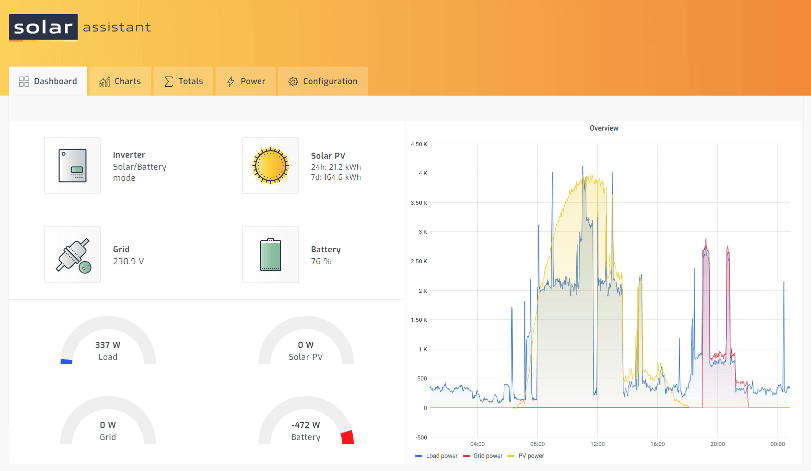
One of the most satisfying aspects of owning a solar system is being able to see in real time exactly what it is doing — how much power your panels are producing, how much your home is consuming, what is going in and out of the battery, and how much you are drawing from or exporting to the grid. Modern monitoring systems make all of this remarkably accessible and genuinely interesting to follow.
What Monitoring Tells You
A good solar monitoring setup gives you a live and historical view of your energy flows:
- Solar generation — how much electricity your panels are currently producing and have produced today, this month, and this year
- Home consumption — how much your household is using in total at any given moment
- Battery state — how charged your battery is, whether it is charging or discharging, and the rate of flow
- Grid import and export — whether you are currently buying electricity from the grid or selling surplus back to it, and at what rate
With this information visible at a glance, it becomes natural to adjust behaviour — putting on the dishwasher when generation is high, charging devices during a sunny spell, or checking the battery before heading out to see whether it is worth running appliances before nightfall.
How Monitoring Works
Most solar inverters come with built-in monitoring that connects to your home Wi-Fi. Data is uploaded to the manufacturer’s cloud platform, where you can view it through a smartphone app or web browser. The monitoring is typically set up by your installer as part of the commissioning process.
Popular inverter brands each have their own apps. Battery systems often have their own monitoring layer too, though many modern integrated systems consolidate everything into a single interface.
Third-party monitoring platforms like Solar Assistant sit between your inverter and the cloud, running on a small local device that communicates directly with the inverter over your home network. This gives you local data access independent of the manufacturer’s cloud service — useful if you want faster data updates, offline access, or integration with home automation systems.
Smart Meters and Half-Hourly Data
If you have a smart meter, your energy supplier receives half-hourly readings of your grid import and export automatically. You can access this data through your supplier’s app, which shows your consumption patterns and export volumes over time.
For SEG export payments, smart meter data is what your supplier uses to calculate what they owe you. It is worth getting familiar with your supplier’s app so you can cross-reference your solar monitoring data with what the supplier is seeing.
What Good Looks Like Day to Day
In practice, most solar owners settle into a simple monitoring habit:
Morning: Check the battery state of charge. Is it full from yesterday’s solar? Has overnight grid charging topped it up if you are on a time-of-use tariff?
Daytime: Glance at generation during the day. A quick look at midday on a sunny spring day — seeing 3 or 4 kW flowing from the panels, the battery charging, the grid meter showing zero — is one of the more satisfying things about owning solar.
Evening: Check daily totals. How much did the panels generate today? How much came from the battery? How much was needed from the grid? Over time, you develop an instinctive feel for what your system should be doing and will notice quickly if something looks wrong.
Using Data to Improve Performance
Monitoring is not just satisfying — it is useful. Reviewing your data over the first few months of ownership helps you:
- Understand which times of day and which months your system generates most
- Identify whether your self-consumption rate is as high as it should be
- Spot anomalies that might indicate a fault — a panel underperforming, an inverter issue, or unexpected consumption from a device left on
- Make informed decisions about when to run high-draw appliances
- Validate that your SEG export data matches what your supplier is paying you
Integrations with Smart Home Systems
For those who enjoy home automation, solar monitoring integrates well with platforms like Home Assistant, Apple HomeKit, or Google Home. Automations can be configured to trigger smart plugs, dishwashers, or EV chargers based on solar generation levels — so the washing machine starts itself when there is enough surplus power to run it for free.
This level of integration is not necessary for most people, but for those who enjoy it, the combination of solar monitoring and home automation can squeeze even more value out of the installation.
The Bottom Line
Modern solar monitoring is intuitive, accessible, and available on your phone wherever you are. It turns your solar investment from a black box on the roof into something you can engage with, understand, and actively use to make better energy decisions. Once you have seen your panels generating 4 kW on a bright April morning while your home runs for free and the battery fills in the background, you will wonder how you managed without it.